Why Can We Access the Internet After Attach?
2026-03-28
This article explains why Attach alone does not enable communication, and how a GTP session establishes Internet connectivity.
Introduction
The process of establishing communication in a cellular network can be divided into two major phases:
- Attach (Control Plane)
→ Why Initial Roaming Connection Takes Time? (March 5, 2026) - GTP Session Establishment (Data Plane)
→ Explained in this article
It is often misunderstood that “having signal means communication is possible,” but in reality, only phase 1 (Attach) has been completed.
■ 1. What Is Completed by Attach
The following are achieved during Attach:
- Subscriber authentication based on IMSI (15 digits)
- Authorization to connect to the Home Network
- UE location registration
At this stage, the UE is only authorized to join the network, and no communication path to external networks such as the Internet exists yet.
As a side note, SMS may be available at this stage, as it is mainly handled in the control plane.
The key point is:
Attach is a control plane procedure and is separate from data communication
From here, the process of establishing a communication path (data plane) begins.
■ 2. What Happens After Attach
Here, we introduce additional elements: APN, GTP tunnel, S-GW, and P-GW.
APN
After Attach, the UE establishes a path to external networks.
APN is a key parameter that specifies which external network to connect to.
In other words, it represents the “exit point.”
GTP Tunnel
A virtual tunnel that carries user data within the mobile network (with an outer header).
S-GW
An aggregation point that collects traffic from base stations (interface between access network and core network).
P-GW
The boundary to the Internet, responsible for IP address allocation and external connectivity.
At the P-GW, the outer GTP header is removed, and packets are forwarded to the Internet as standard IP packets.
Typically, the UE is assigned a private IP address, which is then translated via NAT into a shared global IP address for Internet access.
Internet Connectivity Flow
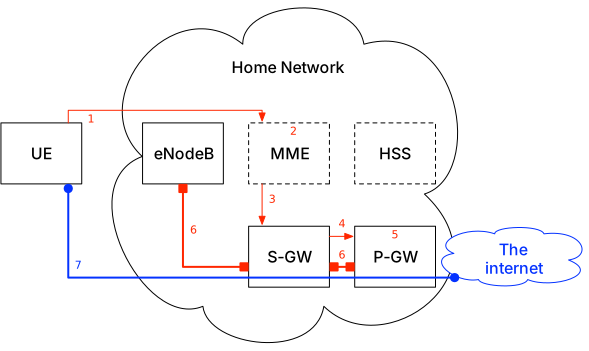
In the figure, 1–6 represent control procedures for session establishment, and 7 represents the start of actual data communication. This separation between control plane and data plane is a fundamental architecture of cellular networks.
| 0 | Attach Completed | ||
| 1 | UE → MME | PDN Connectivity Request (including APN) |
The UE requests connection to a specific APN. It does not know the S-GW at this stage. |
| 2 | MME | Select S-GW | The MME selects the S-GW based on UE location and operator policy. |
| 3 | MME → S-GW | Create Session Request (GTP-C) | The MME requests session creation for the UE. |
| 4 | S-GW → P-GW | Connect based on APN | The S-GW resolves the APN via DNS and identifies the P-GW. |
| 5 | P-GW | IP Address Allocation | A private IP address is assigned to the UE. |
| 6 | eNodeB ⇄ S-GW S-GW ⇄ P-GW |
Tunnel Establishment (GTP-U) | GTP tunnels are established for data transfer. |
| 7 | UE → Internet | Start Data Communication | The UE can now access the Internet. |
Roaming Scenario
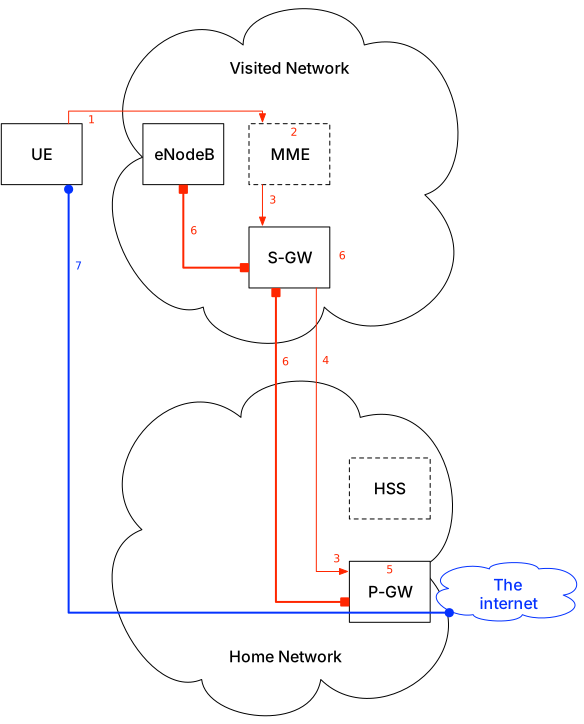
The structure is identical to non-roaming scenarios; only the placement changes.
■ 3. Home Routing vs Local Breakout
In Home Routing, the P-GW is located in the Home Network, meaning traffic is routed back to the home network during roaming.
Path:
UE → Visited Network → [International Link] → Home Network (P-GW) → Internet
This results in increased latency due to round-trip international transmission.
To address this issue, Local Breakout (LBO) is used.
With LBO, traffic is not routed back to the home network but instead exits locally within the visited or regional network.
This introduces multiple P-GWs, raising the question of how the exit point is selected.
This is an important network design topic and will be covered in future articles.
■ Key Takeaway
- The structure (Attach → GTP session) does not change
- Only the location of the Internet exit changes
In other words:
The difference between Home Routing and Local Breakout is not the mechanism, but the placement.