Why Can Devices Stay Connected After Attach? — The Mechanics Behind Handover
2026-04-11
A structural explanation of why IoT devices maintain connectivity while moving, focusing on the post-Attach state, RRC control, and the internal mechanics of handover
Introduction
When connecting IoT devices to a cellular network, a natural question arises:
“Why does communication continue even while the device is moving?”
In this article, we break down that behavior from the perspective of handover.
State Before Handover
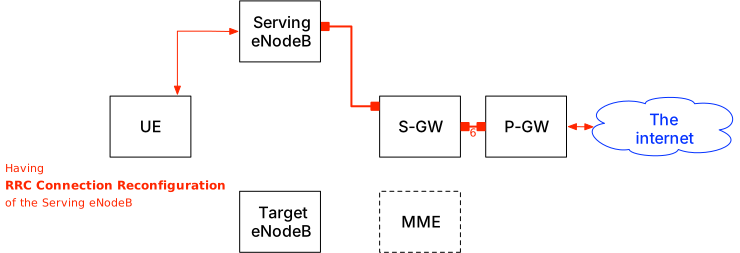
In the previous article, “Why Can Devices Access the Internet After Attach?,” we explained how the GTP tunnel is established. At this stage, the GTP tunnel has already been established, so Internet connectivity is available through the path:
“UE → Serving eNodeB → S-GW → P-GW → Internet”
Here, we also need to touch on RRC Connected state and measurement control and RRC Connection Reconfiguration as additional prerequisites.
RRC Connected State and Measurement Control
After Attach, the UE enters the RRC Connected state and maintains a control-plane connection with the Serving eNodeB. In this state, the UE does not simply communicate; it also performs radio measurements based on conditions instructed by the eNodeB.
What Is RRC Connection Reconfiguration?
The conditions used to determine whether handover should be executed are configured in the UE through RRC Connection Reconfiguration. These parameters include:
- Measurement targets (neighbor cells / frequencies)
- Measurement events (for example, Event A3)
- Thresholds (offset)
- Time-to-Trigger (only considered valid if the condition continues for a certain period)
Based on these conditions, the UE compares the radio quality of the Serving Cell and Neighbor Cell (RSRP / RSRQ), and sends a Measurement Report only when the configured conditions are satisfied.
👉 In other words, the handover trigger does not occur through an autonomous decision by the UE. It occurs according to rules predefined by the eNodeB.
Handover Process 1 (First Half)
Let us first look at the first half of the handover process.
At this stage, the path has not yet been switched, and forwarding occurs in the form:
“UE → Target eNodeB → Serving eNodeB → S-GW → P-GW → Internet”
※ At this point, the S-GW is still sending data to the Serving eNodeB. Therefore, the Target eNodeB receives data via the Serving eNodeB.
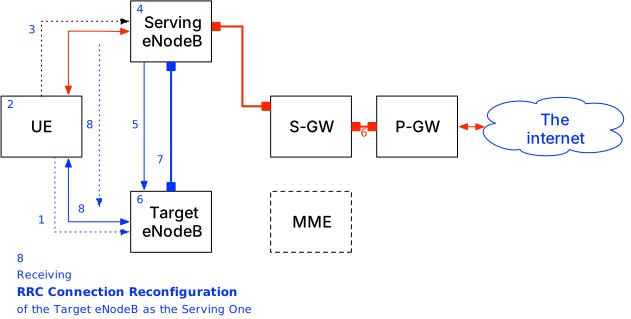
| 1 | UE |
Detects surrounding base stations (eNodeBs) From this point onward, that eNodeB is referred to as the Target eNodeB |
| 2 | UE | Compares the current RRC Connection Reconfiguration conditions with the Target eNodeB |
| 3 | UE → Serving eNodeB |
Sends a Measurement Report if the Target eNodeB satisfies better conditions |
| 4 | Serving eNodeB | Makes the handover decision |
| 5 | Serving eNodeB → Target eNodeB |
Sends an X2 Handover Request |
| 6 | Target eNodeB | Allocates resources |
| 7 | Serving eNodeB ↔ Target eNodeB |
Sets up a GTP tunnel as the data forwarding path A new TEID is assigned to this GTP tunnel |
| 8 | UE |
Executes the handover Receives and replaces the RRC Connection Reconfiguration of the Target eNodeB |
Handover Process 2 (Second Half)
Next, let us look at the second half of the handover process. At this point, the path:
“UE → Target eNodeB → Serving eNodeB → S-GW → P-GW → Internet”
is fully switched to:
“UE → Target eNodeB (the new Serving eNodeB) → S-GW → P-GW → Internet”
👉 This is achieved by the Path Switch, which updates the forwarding destination of the S-GW to the Target eNodeB.
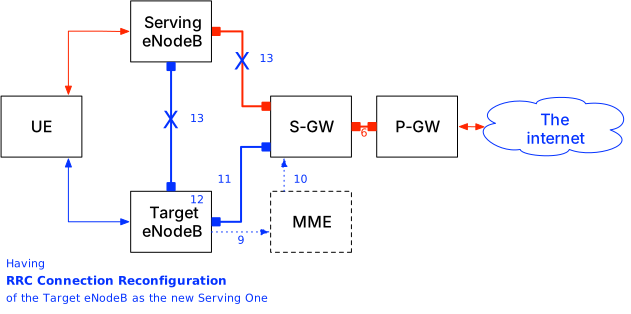
| 9 |
Target eNodeB →
MME
|
Sends a Path Switch Request |
| 10 |
MME →
S-GW
|
Sends Modify Bearer |
| 11 |
Target eNodeB ↔
S-GW
|
Sets up a GTP tunnel as the data transfer path A new TEID is assigned to this GTP tunnel |
| 12 | Target eNodeB |
S1-U is switched At this point, the shortest path is established |
| 13 |
Serving eNodeB ↔
Target eNodeBTarget eNodeB ↔
S-GW
|
Removes the GTP tunnels that are no longer needed |
Roaming During High-Speed Movement
During high-speed movement, cell crossing events occur continuously.
Depending on the environment and cell size, it is not unusual for handovers to be repeated every few seconds.
The key point here is that handover, which is the core process enabling communication continuity, is executed extremely quickly.
As discussed in this article, the entire sequence included in a single handover cycle — from trigger condition satisfaction to Path Switch completion — is completed on the order of milliseconds.
Cell size varies depending on base station deployment, but is generally formed on the following scale:
- Macro cells: several hundred meters
- Small cells: several tens of meters
Now let us consider an extreme case in which the UE crosses cells every 10 meters.
In that case, the relationship between handover processing time and movement speed is as follows:
| Distance / Time | Speed |
|---|---|
| 10m / 1 msec | 36,000 km/h |
| 10m / 10 msec | 3,600 km/h |
| 10m / 100 msec | 360 km/h |
| 10m / 1 sec | 36 km/h |
Conclusion
During handover, the data path temporarily becomes dual-path, and is then switched to the new route.
This is how connectivity can be maintained even while the device is moving.